Equipment:
On occasion, people will ask what type of equipment I use, what type is best to start with, and what I would recommend - to which, I always ask three questions:
-
How much storage space do you have?
-
How much are you willing to carry?
-
What are you trying to see?
Budget is yours to decide. However, if you're completely unsure regarding the three above questions, I typically recommend a pair of binoculars to start with. Because the last thing you want is to purchase a huge, expensive telescope that you'll use twice and turn into a huge, expensive coat rack. Before you get into it, feel free to check out this article from Sky & Telescope on How to Choose A Telescope.
DISCLAIMER: the following recommendations are based on my personal experience. I haven't received any compensation to write this. KKA is entirely self-funded.
Stargazing
I have had these Tasco binoculars for nearly 10 years, and they get the job done for looking at the Moon, large bright comets, like NEOWISE, and star clusters like the Pleiades, Hyades, and Beehive (to name a few).
If you have a camera tripod, you'll want to get a binocular adapter to mount the binos to the tripod; otherwise, your arms may get tired after 10 minutes or so.
Tasco 12x50 Essentials Porro Binoculars


If you're looking to venture into automated territory, the Celestron 90 SLT is a great telescope. I honestly can't stress this enough. It's the Tom Seaver of telescopes. Not only is it easy to transport (mine fits between a standard-sized backpack and baseball bat bag), but you get some pretty darn good lunar and planetary views. Because of this, it touches on all three of my personal requirements: portability, weight, and visibility.
While you'll lose the ability to view open star clusters, this Maksutov-Cassegrain will be able to resolve globular clusters! The giant sparkly ones. And all of this is easy because of the pre-programmed remote it comes with - 36,000 objects worth. Be sure to get the battery pack, or you'll burn through AAs like nobody's business.
Now, if you feel like the 90SLT is too small and you want a scope with more meat, you might be interested in the Celestron 6SE.
There are some stark differences between the 90SLT and 6SE – namely, the size. The 6SE has an additional three inches in diameter, which means it gathers more light and gives you better resolution on just about everything.
Downside: With size comes weight. If you don't have a car and want to bring it places, it might be a challenge. Plus, you'll still need the battery pack, which only adds to the weight. You can cut weight by getting a tabletop tripod (I named mine Baby Legs). Since this is a Schmidt-Cassegrain type, it requires more collimation, or adjustments, if it is accidentally misaligned. But this telescope has a solar filter you can purchase, ensuring you get the most out of it.
Celestron 6SE Telescope, Powertank, & EclipSmart Solar Filter


If automation has your head spinning, you can always stick with a manual telescope; you'll enjoy the Sky-Watcher StarTravel 120.
Since this is manual use, you will not need a battery. But the tripod can be a little cumbersome to carry, and the scope may get a little heavy after carrying it for a distance.
But you can resolve planets, our moon, and nebulae with it, which is a huge bonus. Also, since it is a refractor, it is more "telescope-shaped", which can be more eye candy. As of 2024, the StarTravel 120 is no longer produced, but that doesn't mean you can't find a comparable refractor.
Solar Observing
Certain telescopes are designed specifically to observe the Sun and cannot be used for nighttime observing. When observing the Sun with one of these telescopes, you must use extreme caution. I cannot stress this enough – never, ever look at the sun without proper eye protection. This goes for telescopes, binoculars, and solar glasses. Incorrect use of a standard telescope or binoculars can result in permanent, irreversible eye damage that will leave you blind.
When looking for solar glasses, make sure they are ISO 12312-2 certified. Learn more about How to Tell If Your Solar Glasses Are Safe here.
With that said, you can learn about solar telescopes here.

For sunspot viewing, I have the Sky-Watcher SolarQuest system. This operates with a 70mm white-light refractor designed exclusively for viewing the Sun.
It runs on 8 AA batteries and can last a long while. But if you want to convert it to a 12-volt battery, you can do that as well. This telescope was generously donated by the Charlie Bates Solar Astronomy Project.
What's especially awesome about this scope is that it tracks the Sun for you once you turn it on. No programming required!
With the Coronado off the market and hard to find, most amateur astronomers find themselves purchasing a Lunt. I have a 50mm hydrogen-alpha solar scope that provides a wider view of the Sun's prominences and filaments. Additional details, such as faculae, can also appear more clearly with this telescope.
While it is a little heavier than the Coronado (Coronado is 3 lbs, Lunt is 8 lbs), it also does not require batteries. If you can mount it to a battery-operated tripod, it will track the Sun for you with little trouble.


Finally, I have the Heliostar 76 H-Alpha Solar Telescope with a SolarQuest Mount, a telescope kit generously donated by the team at Sky-Watcher USA.
Like the one above, this SolarQuest mount also runs on 8 AA batteries and can be converted to a 12-volt battery for longer views of our home star. The larger aperture lets me catch solar prominences, spicules, bright plage patches, surface granulation, plasma filaments, and more. Weight-wise, the whole setup clocks in around 25 lbs, which makes it the heaviest solar scope I have, but easy enough to carry on the NYC subway!
Smart Telescopes
Smart telescopes hit the market around 2018 and have boomed in popularity and type. These telescopes are specifically designed for astrophotography. They typically come with no eyepiece for you to look through. Instead, they rely on a digital screen via Bluetooth, such as a smartphone or tablet. Smart telescopes are fantastic because they allow you to photograph deep sky objects that you might not see in light-polluted skies. They can also be used for Electronically Assisted Astronomy (EAA) when conducting outreach with large crowds or with people who have difficulty using an eyepiece.
For a quick grab-and-go, I have the Seestar S50 telescope. Weighing in at 5 lbs, this telescope provides incredible views of our universe right from the light-polluted streets of NYC. Admittedly, the only struggle I have with this telescope is that it's so small, I have to bring a larger tripod to keep it off the ground. If you are looking to get into astrophotography without the massive learning curve, this is the way to go.
Seestar S50 (now in S30 and S30 Pro!)

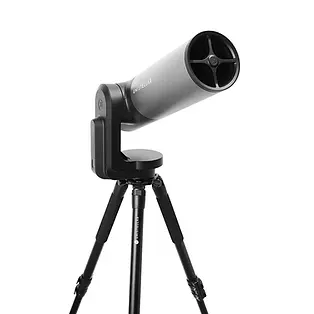
Smart telescopes are not spared when it comes to aperture fever. The Unistellar eQuinox 2 telescope not only has a longer focal length and a higher f-ratio, but it's also a great telescope for NASA Citizen Science projects, like exoplanet hunting and asteroid occultations! And if you have experience processing RAW photo data, you can download the photos taken with this telescope in that format, allowing your creativity to shine through during outreach sessions.
This telescope is on loan from the Astronomical Society of the Pacific.